


- Additive manufacturing
- Advanced membranes
- AI
- American Physical Society
- ASC
- Astrophysics
- Atmospheric, Earth, and Energy
- Batteries
- Battery materials
- Bay Area Science Festival
- Biofuels sfa
- Biological Accelerator Mass Spectrometry
- Biosciences and Biotechnology
- Biosecurity
- Biosecurity & Bioscience
- Biosecurity and Bioforensics Group
- Biosecurity sfa
- Capacitive deionization
- Carbon nanotubes
- Carbonate materials
- Center for Accelerator Mass Spectrometry
- Center for Applied Scientific Computing
- Center for High Energy Density Science
- Charity
- Community
- Community gift program
- Computing & Simulation
- Counterterrorism
- COVID-19
- Ct vaccine center
- DARPA
- Data Science
- Data Science Institute
- Defense and Deterrence
- Discovery Center
- DOE
- Earth system science
- Education
- Emergency
- Energetic Materials Center
- Energy flow charts
- EOS and Materials Theory Group
- Expanding Your Horizons
- Forensic Science Center
- Fun with science
- Fundamental Science
- Fusion
- Gemini Planet Imager
- Glenn T. Seaborg Institute
- Global Security
- HEAF
- High Energy Density Science
- HOME Campaign
- HPC
- HPC Innovation Center
- HPC4Mfg
- Hydrogen production
- Hydrogen storage
- IEEE
- Inclusion
- Inertial confinement fusion
- Intelligence
- Internships
- Jupiter Laser Facility
- Laboratory for Energy Applications for the Future
- Laser Materials
- Lasers
- Lasers and Optical Science Technology
- Livermore Center for Quantum Science
- Livermore Computing
- Livermore Valley Open Campus
- Livermorium
- LLMDA
- LLNS
- Machine learning
- Materials Science
- Microbiology and Immunology Group
- Nanocrystal solar cells
- Nanoscience
- NanoSIMS
- National Ignition Facility
- Neural devices
- Neutrinos
- Newsline
- nEXO
- NNSA
- Nonproliferation
- npneq
- Nuclear
- Nuclear and Chemical Sciences
- Nuclear and Particle Physics Group
- Nuclear Chemical and Isotopic Science
- Nuclear forensics
- NuSTAR
- Office of Science
- Outreach
- Oxidation and degradation
- pcmdi
- People
- Periodic table
- Physics
- Planetary Defense
- Postdocs
- Procurement
- Quantum Simulations Group
- Rare-earth elements
- Rubin Observatory
- Science
- Science and Technology Review
- Science on Saturday
- Sequestration
- Soil microbiome sfa
- Solar
- Solar system
- Solid-state batteries
- Space
- Space Science Institute
- STEM
- Stockpile stewardship
- Students
- Summer Student Spotlight
- Supercapacitors
- Supercomputer
- Supercomputing
- Surface analysis
- Sustainability
- Technology Transfer
- Tours
- Transport system
- Traumatic brain injury
- User Facility
- Veterans
- Viruses
- Water
- Water research
- Weapons
- Women in STEM
- Women's Hall of Fame
- WWW Research Landing Page
- X-ray
Back
NuSTAR

NuSTAR provides explosive evidence for supernova asymmetry
New results from the NASA NuSTAR telescope show that a supernova close to our galaxy experienced a single-sided explosion.A team of scientists including Lawrence Livermore National Laboratory researchers found that X-ray emissions taken with the Nuclear Spectroscopic Telescope Array (NuSTAR) show that the Supernova 1987A explosion was highly asymmetric. The results appear…

Giving shape to black holes' intense winds
By looking at the speed of ambient gas spewing out from a well-known quasar, astronomers are gaining insight into how black holes and their host galaxies might have evolved at the same time.Using the Nuclear Spectroscopic Telescope Array (NuSTAR), researchers were able to use the X-ray spectra of an extremely luminous black hole (quasar PDS 456) to detect a nearly…

Dead star shines on
A supernova is the cataclysmic death of a star, but it seems its remnants shine on.Astronomers have found a pulsating, dead star beaming with the energy of about 10 million suns.This is the brightest pulsar -- a dense stellar remnant leftover from a supernova -- ever recorded, and was seen using NASA's Nuclear Spectroscopic Telescope Array, or NuSTAR.LawrenceLivermore LLNL…
NuSTAR helps untangle how stars explode
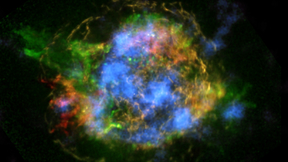
For the first time, an international team of astrophysicists, including Lawrence Livermore National Laboratory scientists, have unraveled how stars blow up in supernova explosions. Using NASA's Nuclear Spectroscopic Telescope Array (NuSTAR ) -- a high-energy X-ray observatory -- the international collaboration created the first-ever map of radioactive material in a…

NuSTAR opens out of this world view thanks to Lab technology
For astrophysicist Bill Craig and his team, NASA's NuSTAR will open up a whole new world. In fact, NuSTAR will allow them to observe a new class of objects in space, called extreme objects, which have never been seen. The Nuclear Spectroscopic Telescope Array (or NuSTAR), is the first focusing, high energy X-ray NASA satellite that will open the hard X-ray sky for…